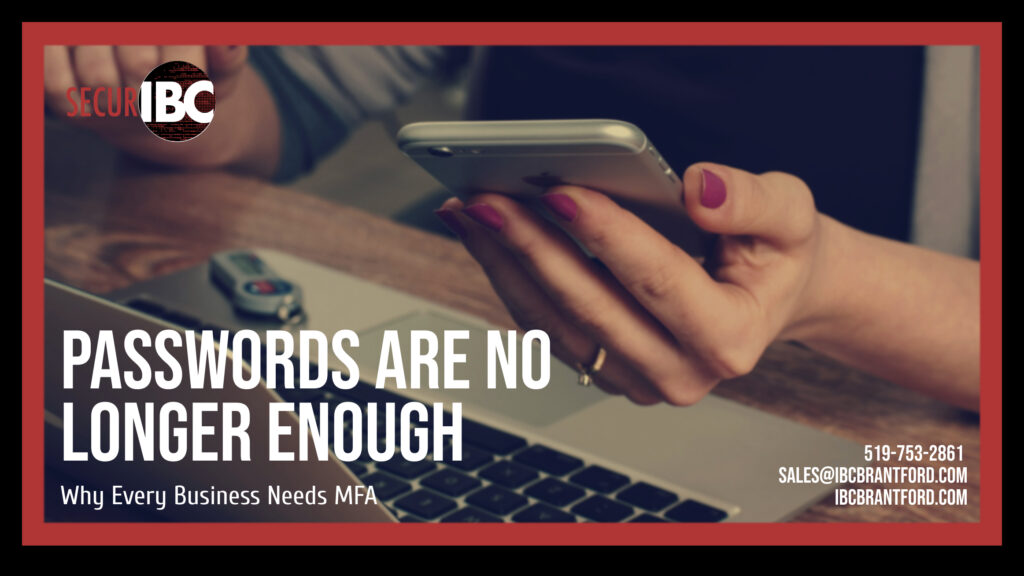
For years, businesses relied on passwords as their primary layer of protection. Today, that’s simply not enough.
Phishing attacks, password leaks, and credential theft have become extremely common — and small businesses are often targeted because attackers assume security is weaker.
This is why Multi-Factor Authentication (MFA) has become one of the most important cybersecurity protections businesses can enable.
MFA adds a second verification step when someone logs into an account. So even if a password is stolen, access is much harder to gain. In many cases, that extra layer is what stops a compromised password from turning into a serious security incident.
The systems most commonly targeted today include:
- Microsoft 365 accounts
- Business email
- Remote access tools
- Administrator accounts
And once a single account is compromised, attackers can often move quickly through email, files, and connected systems.
Microsoft research found that MFA reduces the risk of account compromise by over 99%, and Microsoft has repeatedly reported that the vast majority of compromised accounts did not have MFA enabled.
That’s why MFA is no longer viewed as an “extra” security feature — it’s becoming baseline protection for modern businesses, and increasingly expected by cyber insurance providers and security standards.
The good news is that modern MFA is much easier to use than it used to be. Most people already use it for banking, shopping, and personal apps every day.
Passwords can be stolen in seconds.
MFA makes them much harder to use.
If you have questions about securing your business systems, IBC provides Managed IT and cybersecurity services for businesses across Southern Ontario.
👉 Curious to hear from other business owners — has your company fully adopted MFA yet, or are there still systems where it hasn’t been enabled?